Showing posts with label OpenSimulator. Show all posts

June 9, 2017

Using SoaS to Create Virtual Worlds Offline: Free Webinar for Educators - June 17, 2017

"Beyond Second Life: Creating and Saving Virtual Worlds Offline"

Free Webinar for Educators

Learn how to use virtual worlds in your classes, even when there's no Internet connection, or the school's firewall prevents you from accessing an online grid. This presentation/webinar will take place on Facebook. If you would like to participate, please join Teaching with SoaS group on FB.

When: June 17, 2017 - 10 AM SLT / 17:00 UTC / 18:00 Lisbon

Where: Teaching with SoaS Facebook Group
URL: https://www.facebook.com/groups/teachingwithSoaS/

This event is part of #SLMOOC17

April 15, 2016

Teaching in Virtual Worlds: OAR files, Sim-on-a-Stick, and Kitely

This post was written for SL MOOC 2016


Resources for Teachers:
OAR files, Sim-on-a-Stick, and Kitely


OAR

I love OAR files! They're the perfect way to save and share an entire SIM.
The OpenSimulator Archive (OAR) function has existed since OpenSimulator 0.5.9. The facility does a similar job to load-xml2/save-xml2 in that it saves prims so that they can be later reloaded. However, OpenSimulator archives (OAR) go a step further in that they can save all the necessary asset data so that you may fully restore the terrain, region parcel data, the textures of objects and their inventories when loaded onto a completely different system using a different asset database. ~ http://opensimulator.org/wiki/OpenSim_Archives
There's a considerable collection of ready-to-use islands in OAR format available for free. The ones created by Linda Kellie can currently be downloaded from Zadaroo. There are also free OAR files created by Ener Hax available at http://enerhax.com/

SoaS

Right now you might be wanting to ask me: "I don't have any virtual land. How, and where, will I be able to try these ready-to-use-islands?" And my answer would be: "No problem. You can use Sim-on-a-Stick."


Sim-on-a-stick (SoaS) is a virtual world developed by Ener Hax that works on your computer and its not connected to the Web. You can download it for free at http://simonastick.com/ 
2. what's Sim-on-a-Stick? A standalone, single user Windows package of OpenSim that runs on a USB flash drive or other convenient location. In addition to the OpenSimulator server, it contains the Apache web server, MySQL, and PHP in order to create a "portable" server. ~ http://simonastick.com/faqs08.html
Using SoaS will allow you to experiment building your own virtual learning environments for free - i.e. without having to rent an entire SIM in order to do it. You will also be able to save multiple versions of your work as it evolves, as easily as you would with any simple presentation. Furthermore, collaboration with others is possible: all you need to do is to save your OAR file and then send it to the person you're collaborating with, using Dropbox or a similar service.

The collage below illustrates the very first virtual learning environment I developed from scratch using SoaS, several years ago.

Collage of a SIM I created using SOAS. The textures for the granaries (picture in the middle on the right column) were obtained by photographing real-life traditional granaries at the villages of Soajo and Lindoso, in the Minho region, Northwestern Portugal.  

And here's a video tutorial I made a few years ago, explaining how to (legally) turn prim items into mesh objects, using Singularity. The first part of the tutorial takes place on that same virtual environment I created using SoaS.


A little final note about SoaS: although it is called Sim-on-a-Stick (aka Flash drive aka USB drive), in my experience, SoaS works much better/faster when you run it on a computer's hard disk.

Kitely

Kitely backup options
Working offline on your virtual learning environment for as many hours as you wish is a great thing, but there might come a time when you feel like sharing your final work with the World... or just your students.
When it comes to connecting your virtual world to the Web, there are several options within public and private grids that support OpenSimulator. One my favorite grids is Kitely. It's not free, but it's not very expensive either, and it makes uploading and saving a SIM in OAR format quite simple.

Hope this post has helped you expand your virtual learning environments builder's toolbox. Feel free to ask me any questions about these resources.


November 13, 2014

OSCC14 - Does OpenSim have the critical mass to survive

Broadcast live streaming video on Ustream
The OpenSimulator Community Conference is an annual conference that focuses on the community around the OpenSimulator software. The conference features two days of presentations, workshops, keynote sessions, and social events across diverse sectors of the OpenSimulator user base, including: - Business and Enterprise - Content & Community - Development and Open Source - Education and Research - Learning Lab The second annual OpenSimulator Conference is organized as a joint production by the Overte Foundation and AvaCon, Inc., and hosted on an OpenSimulator grid specifically designed for the conference. More at: http://conference.opensimulator.org

January 28, 2014

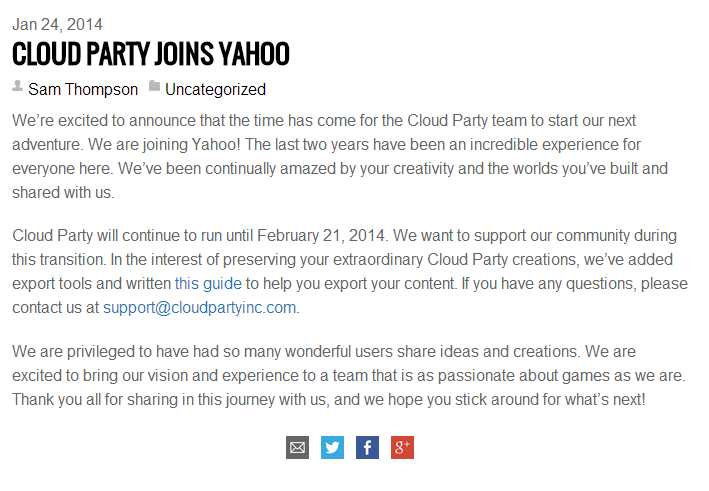
Cloud Party encerra dia 21 de Fevereiro. Mais um ponto a favor do OpenSim?


Cloud Party vai encerrar em Fevereiro. Trata-se de mais um exemplo do pesadelo receado por qualquer criador/formador/organização ao escolher uma plataforma para investir na criação de um espaço virtual: a possibilidade de a empresa que gere a plataforma escolhida fechar as portas com 30 dias, ou menos, de pré-aviso. Neste caso, todos os conteúdos que não puderem ser exportados do Cloud Party serão perdidos pelos actuais utilizadores.

O Cloud Party tinha a grande vantagem de utilizar tecnologia WebGL, permitindo a sua utilização com recurso a um simples Web browser, sem necessidade de instalar qualquer software. Esta característica transformava a plataforma numa excelente porta de entrada para primeiros utilizadores - pessoas que nunca tinham experimentado um ambiente virtual tridimensional - algo que pude verificar em primeira mão, nas iniciativas que organizei.

Imagem de um ambiente virtual criado pela autora na plataforma Cloud Party


Haverá sempre uma nova plataforma para experimentar, com novas funcionalidades e preços competitivos, mas a questão permanece: quanto tempo irá durar?

Talvez resida nessa dúvida a razão pela qual cada vez mais organizações optam por desenvolver os seus ambientes digitais tridimensionais recorrendo a tecnologia OpenSim e alojando-as nos seus próprios servidores. 

Imagem de um ambiente virtual criado pela autora, utilizando tecnologia OpenSim

Tal como comentou Ilan Tochner, em resposta a um artigo sobre este tema, escrito por Maria Korolov, a tecnologia OpenSim pode não ser tão apelativa como WebGL ou Unity3D, mas continua a ser a opção mais segura para quem pretende implementar um projecto sem recear ver grande parte (ou mesmo a totalidade) do seu trabalho perdida, devido a uma decisão de gestão tomada por terceiros.

Cloud Party is dead. Long live OpenSim?


September 11, 2013

Mundos Virtuais: Crista Lopes sobre as razões para os actuais limites de capacidade das regiões #OSCC13


A maioria dos utilizadores de mundos virtuais já experimentou situações em que se torna impossível funcionar numa determinada região devido ao elevado número de avatares nela presentes, mesmo quando o limite teórico do simulador se encontra ainda distante. Como alguém me disse há muito tempo: «Nos mundos virtuais, a principal fonte de Lag são as pessoas.»

Numa das suas intervenções, no âmbito da #OSCC13, Crista Lopes falou sobre os motivos que levam a estes limites de capacidade das regiões criadas com recurso à tecnologia OpenSimulator (e também no Second Life).

Segundo Crista Lopes, não se trata apenas de um problema de configuração (i.e. falta de capacidade) dos servidores, o problema reside igualmente nos viewers, que simplesmente não suportam lidar com a presença de um elevado número de utilizadores numa única região. Assim, qualquer desenvolvimento ao nível da arquitectura dos servidores, terá de ser acompanhado por igual investimento nos viewers, pois, caso contrário, estas situações continuarão a acontecer - bastando para tal que um evento atraia mais do que uma dezena ou duas de utilizadores a regiões que teoricamente deveriam suportar 100 avatares.


O vídeo acima é um excerto da gravação da Opening Keynote da #OSCC13.
A gravação integral da sessão encontra-se disponível em:
http://www.ustream.tv/recorded/38381879

September 10, 2013

Mundos Virtuais: como transformar os velhos prims em novos modelos mesh (video tutorial)


Neste tutorial é explicado como se pode criar modelos mesh a partir de itens baseados em prims (com ou sem sculpts), recorrendo a uma funcionalidade do viewer Singularity. Importante: o procedimento exemplificado só resulta se o utilizador for o criador de todas as componentes do item que pretende exportar.

September 9, 2013

#OSCC13 Dos Sonhos do Passado à Realidade do Futuro: uma apresentação inspiradora de John 'Pathfinder' Lester

Video streaming by Ustream

Os slides da apresentação:


O vídeo mencionado pelo autor na apresentação, que relata as primeiras experiências de interligação entre Second Life e OpenSim, entretanto descontinuadas pela LindenLab.


O autor mantém um mundo virtual - Pathlandia - que se encontra aberto a todos os visitantes.
Imagem de John Lester


As instruções para visitar Pathlandia encontram-se disponíveis em: http://becunningandfulloftricks.com/2012/01/09/my-diva-standalone-opensim-grid-pathlandia/


Sobre John Lester:


Exploring the Interconnected: How Past Dreams evolve into Future Re...

Mais vídeos das apresentações que tiveram lugar no âmbito desta conferência em:
http://conference.opensimulator.org/2013/streaming/

Tradução automática

LinkWithin

Related Posts with Thumbnails

Search This Blog